Weather: 50 degrees and cloudy/spitty rain
Steps walked: Shaun - 8,281, 32 stairs climbed; Shannon - 6,941, 32 stairs climbed
Critter count: 4 adults male orcas, a mother and calf orca, and about 10 juvenile male orcas (and I do mean juvenile), maybe 20 humpbacks including a mama and a baby, 2 juvenile bald eagles, a shitload of pink salmon, several sea otters, and bear scat but no bears

How in the world can I possibly describe the day we had today? It's gonna be hard, but I'm going to give it a try (this is Shaun by the way). This morning we were awoken by the dulcet tones of our lovely expedition leader/tour director, Cindy. She said very calmly that it was no big hurry, but that we were entering Chatham Strait, and we were "encountering" a few whales. Shannon and I took her at her word and leisurely got dressed and brushed our teeth and strolled onto the deck with our cameras. Indeed, there were a few humpbacks doing what humpbacks do, which is basically blowing, rolling over the surface, and then diving with their flukes in the air. There were about 3 or 4 of them doing their thing, and it was really cool. I was having problems with my camera, though, so I was distracted and out of sorts. I just watched them while Shannon tried to make my camera work. We were trying to work with the continuous burst button so that we could have a better chance of getting photos of whales, but we were obviously doing something wrong. I ended up having to reset the whole damn camera back to the default setting.
Anyway, Anna-Marie (our hotel manager - which I think is a really weird title) called us all to breakfast which everyone pretty much ignored. Finally, Cindy made the announcement that we would be hanging out with the whales for another hour or so and that everyone needed to come eat, so we did. At breakfast, I worked with one of the other 3 women who have the same camera as me trying to fix the dang thing, which made me not get to much of my breakfast. Once again, Cindy came on the speaker with her next announcement. She said that she knew she told us to eat our breakfast, but that there were now orcas spotted in the area and we needed to get our butts onto the deck. Okay, maybe she didn't put it exactly that way, but that's what she meant!
We all went racing onto the deck to see the orcas, and at that point, basically all hell broke loose. For the next 2 hours we were entertained by a mixture of humpbacks and orcas that was so extraordinary, even the naturalists were agog. No one knew where to look because they were frickin' everywhere! There was a group of males who played and flapped and flipped and spy-hopped and climbed all over each other. There were 4 HUGE males who kept their distance at first but then came in to see what the heck was going on. The humpbacks were right in with the orcas and were not in distress at all. This group (or groups) of orcas were resident orcas who eat fish, so they were no threat to the humpbacks who seemed to know this because they were just one big happy mess of marine mammals. Even the sea otters we saw a little later were not concerned when several of the orcas swam right by them. As a naturalist noted, the other kind of orcas are called transient orcas, and they eat mammals, including baby humpbacks, which is how we knew that these orcas were residents because the humpbacks would have beat feet away from them for sure.
Another interesting phenomenon we witnessed was what the naturalists call a "Pink Floyd" which is an erect orca penis that we were treated to several times during our morning commune. Naturally, I was very interested in this phenomenon being a connoisseur of all forms of male genitalia, but unfortunately, I never got to see it (despite my running all the way to the lounge to get stronger binoculars!). Shannon thought she caught a picture of it, but we can't find it now, so bummer for you!
It was crazy fun. Everyone was pointing out stuff to each other, and you were looking left and right and straight and seeing humpbacks breaching and orcas spy hopping and flipping their flippers and flukes all over the place and then there would be a Pink Floyd sighting (which I naturally ALWAYS turned towards), and you absolutely could not take it all in. In between all this are the naturalists trying to tell you about what you're seeing and the photographers telling you to be on sports mode and all that, and it was pandemonium in the best possible way. At one point, this woman was trying to draw attention to the 4 big orca males that were coming closers, but all she could get out was, "Big, big, big!" It was a riot.

Imagine all 60 people on the ship....along with all of the naturalists, all vying for position, trying to catch things on film. I finally gave up and just watched which was very freeing, and Shannon did her best to be the family photographer. She did a great job, and we got some very special shots. It was hilarious, though, because the main photographer, Rich...he is a very funny man. He kept up a running commentary on what we were seeing and how crazy it was and all that. One guy caught him on the stairs and asked if there were any whales, and Rich said, "Are you kidding me? It's whale soup out there!" That totally sums up our experience because there were whales everywhere we looked, and through it all were this group of juveniles who refused to be outdone by anyone, including the massive males who came along later. We listened to their sounds through the hydrophone and the very different blow sounds of the orcas and the humpbacks. They chatted with each other the whole time, and Cindy just stood there and giggled and couldn't believe we were having this extraordinary experience.
(there are sea lions on that beach. See them?)
So....eventually the whales moved on, and we all went inside to warm up. The ship moved towards Peril Strait which is a long, twisty waterway between the ABC islands of Admiralty, Baranof, and Chichagof. About 30 minutes later, Cindy announced that we had another delay....I'm thinking we're having technical problems with the ship...but no....there's more dang orcas! This time it's a mama and a baby and another female. Holy crap, seriously? Some people were very blasé this time, though, and didn't bother to go out on deck. I said to heck with them and went out and had more orca fun, cuz let's face it...this is what we came to Alaska to see, and I was going to milk it for all it was worth. There were a few more humpbacks in the mix, and then we got close to a couple of islands...one where sea otters were hanging out and another where Stellar sea lions were sunning on the beach. It was weird because the orcas swam very close to the otters, and neither of them bothered the other in the least.
Before lunch, we were treated to a presentation by Rich (the photographer) about one of his passions, time lapse photography. It was totally over my head, but it was still interesting to see his work, and he is helping many conservation organizations by providing visual proof of various problems that need to be addressed in the naturalists' world.
After lunch, we were treated to ANOTHER presentation by Andy, the head of the Alaska Whale Foundation who was also a professor at a couple of universities and a sponsor of graduate students. He had a whole bunch of other credentials too, but the most important thing about Andy to Shannon and me was that he is an expert on all aspects of humpback whales...especially their feeding habits. This guys was SMART with a capital S and a super good speaker. He was also very cute, too, so we had a very enjoyable hour listening to him talk about the various marine mammals in the area.
Once he got to the humpback whales, though, you could just feel his passion, and we learned all about the Pacific Northwestern whale population. These animals are unique in all the world because 95% of them winter and breed in Hawaii exclusively. They only breed with other Hawaiian whales and keep the gene pool very clean. However, there is nothing to eat in Hawaii (crazy huh?), so for 5 months the females take in no nourishment at all despite the fact that they are nursing their calves during that time and traveling so far. They lose a third of their body weight during that time, which is why they're so hungry when they get back to Alaska. Thank goodness the waters here are so rich in food for them!
Pacific Northwestern whales also exhibit some interesting feeding adaptations, one of which is called bubble net feeding. In bubble net feeding, one whale goes way below the surface and blows a ring of bubbles around a school of herrings. Another whale emits a very distinct sound that scares the herring, and between these 2 behaviors, the herring stay within the net and don't swim below it or in between the bubbles. The other whales in the group (which can be between 2 and 24 animals but are usually 8-10 individuals) come up from underneath the net and gulp 12 telephone booths worth of water and herring into their mouth (Shannon and I don't remember the number of gallons). They strain all the water out and are left with only the herring. If you want to see it in action, go to YouTube. There are some great videos showing the phenomenon.
It turns out that, of the 20,000 humpbacks in the Pacific Northwest, only 50 or 60 of them practice bubble net feeding, and of that group, only 6 or 7 do the actual netting and vocalizing. Also, the 6 or 7 specialists, as they're called, usually work with the same partner through the years, and these whales live to be upwards of 100 years old! The partners are not necessarily related to each other, and it doesn't appear that they teach their skill to their children either. They think the specialists just learn by trial and error after having been in a bubble netting group that loses their specialists.
Another interesting feeding adaptation of whales in this area is used by sperm whales, which never used to come to this area, but about 13 years ago, a couple of whales came into the Inside Passage and figured out that the long line fishermen had halibut and black cod attached to their fishing lines. The whales will find a long line boat and sleep by it until the boat's wench starts up and then they proceed to pluck every one of the fish off the line! Can you imagine? The fishermen have no recourse but to just pack up and leave because there's nothing you can do to make a sperm whale move on if he doesn't wanna.
(How do you like my alien baby?)
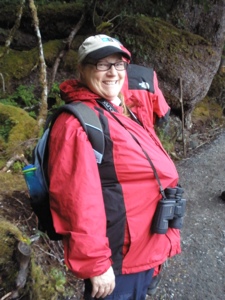
After Andy's presentation, we cruised until we got to Lake Eva where there was a lovely salmon stream that had a nicely maintained trail. Shannon and I once again chose to join the combo naturalist and photography walk with Emily and Jennifer (it's starting to be a stalking situation), because this is usually the medium walk with equal amounts walking and talking. There is usually an "adventure" walk with very little talking and then a "stationary" walk for the real photo geeks.
We walked through another insanely beautiful forest that had previously been logged, which gave it a surreal quality as the nurse logs provided the place for new growth to happen. Sitka spruce and western hemlock make up 85% of the forests around here, and it's hard to realize that some of these trees are 300 years old....and it's only at that point that they're considered "old growth". The soil here is quite inhospitable, so the tree roots only go 6-8 inches down, which makes them vulnerable to wind. It was interesting, though, because we saw some trees that had been blown down across the path, leaving behind giant root balls, but they were still alive!
There are so many interesting things in the forest that we ended up having to hoof it to the salmon stream because we had spent so much time checking out mushrooms and lichen and all kinds of other cool stuff. Once we got to the stream, we found a banana slug that was seriously cool, and Shannon actually held it...and then....she put her tongue on it! Apparently banana slugs have a lidocaine-type substance in them that she agreed to test out for the group. The result of her experiment was....a little tingling on her tongue....or she could have been imagining it. Who knows?
At the stream we watched the fish jump all over the place. The water was so full of fish that it was black, but we didn't see any bears...just the remains of their meals and the results of their digestive process. We had to climb down over and under roots and rocks and stuff like that which Shannon really liked but I didn't. It was too scary for little ol' me!
After our walk to Lake Eva, we returned to the ship, got changed since we were drenched in sweat, and proceeded to the lounge for a wine tasting/hors d'oeuvres party with a video of the underwater work that our divers, Ian and Billy, did for us. While down there, they were able to videotape a giant octopus (that was not very giant) and a 20-legged starfish. It was amazing to see such abundance under the water, like viewing a coral reef. Just beautiful.
We also got some training on working with a macro lens for up close work from Rich, and then....it was time to eat again of course! Shannon tried to the black cod or sablefish...and Shaun chickened out and had pork loin. We had a very entertaining group at our table, and we learned about French chef training during which the first thing you learn is how to cut potatoes 250 different ways. Believe it or not, it was fascinating!
Well, that's about it for this wonderful day in Chatham Strait and the ABC Islands of Alaska. As far as I'm concerned, there's nothing that could possibly beat this day....but I'm willing to let Lindblad/National Geographic give it the old college try!
And one last whale picture: